Every day, millions of people take medications to relieve pain, fight infections, manage chronic diseases, or improve their overall health. Whether it’s a simple headache tablet or a life-saving cancer treatment, every drug follows a fascinating journey through the human body before it produces its intended effects. Understanding how drugs work not only helps patients appreciate the importance of proper medication use but also promotes safer and more effective treatment.
In this article, we’ll explore the science behind how drugs interact with the human body, from the moment they are taken until they are eliminated. We’ll also discuss the factors that influence drug effectiveness and why following medical advice is essential.
What Is a Drug ?
A drug is any chemical substance that changes the way the body functions. Drugs can be used to prevent, diagnose, treat, or cure diseases. Some medications relieve symptoms, while others target the underlying cause of an illness.
Drugs come in many forms, including:
- Tablets and capsules
- Syrups and liquids
- Injections
- Creams and ointments
- Eye and ear drops
- Inhalers
- Patches applied to the skin
Each type of medication is designed to deliver the active ingredient to a specific part of the body or into the bloodstream.
The Journey of a Drug Through the Body.
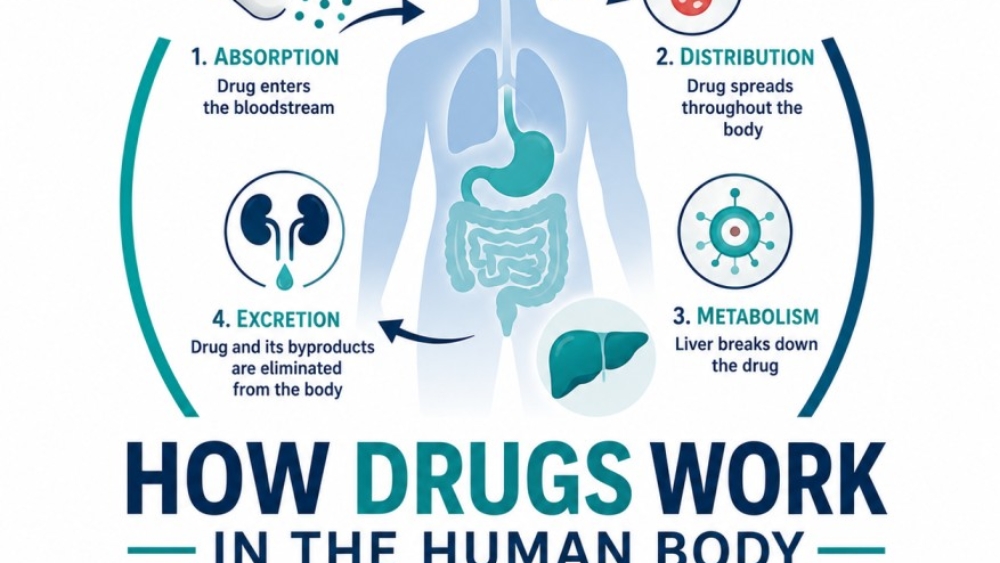
After a drug enters the body, it goes through four important stages commonly known as ADME:
- Absorption
- Distribution
- Metabolism
- Excretion
These processes determine how much of the drug reaches its target, how long it stays active, and when it leaves the body.
1. Absorption: Entering the Bloodstream.
Absorption is the process by which a drug enters the bloodstream after administration.
The route of administration greatly affects how quickly a drug is absorbed.
Oral medications are swallowed and pass through the stomach into the small intestine, where most absorption occurs. The small intestine has a large surface area and rich blood supply, making it highly effective at absorbing drugs.
Injected drugs often enter the bloodstream much faster because they bypass the digestive system. Intravenous (IV) injections provide immediate drug delivery, while intramuscular and subcutaneous injections release medication more gradually.
Inhaled medications reach the lungs and are absorbed rapidly because of the lungs’ extensive network of blood vessels.
Topical medications applied to the skin are generally absorbed slowly and often work locally rather than throughout the body.
Several factors influence absorption, including:
- Food in the stomach
- Stomach acidity
- Drug formulation
- Blood flow
- Age
- Overall health
For example, some antibiotics should be taken on an empty stomach because food can reduce their absorption.
2. Distribution
After absorption, the bloodstream carries the drug throughout the body. This process is called distribution.
Blood acts as the body’s transportation system, delivering drugs to various organs and tissues. However, drugs are not distributed equally throughout the body.
Several factors influence distribution, including:
- Blood circulation
- Body fat percentage
- Water content
- Plasma protein binding
- Tissue permeability
Some organs, such as the liver, kidneys, and brain, receive a rich blood supply, allowing drugs to reach them quickly.
Certain protective barriers also influence drug distribution. One of the most important is the blood-brain barrier, which prevents many drugs from entering the brain while allowing only selected substances to pass.
3. Metabolism.
Metabolism refers to the chemical alteration of drugs inside the body.
The liver is the primary organ responsible for drug metabolism. Liver enzymes convert drugs into forms that are easier for the body to eliminate.
Drug metabolism generally occurs in two phases.
Phase I Metabolism
During this phase, enzymes chemically modify drug molecules through oxidation, reduction, or hydrolysis. These reactions often make drugs more water-soluble.
Phase II Metabolism
In this phase, the modified drug combines with another substance such as glucuronic acid or sulfate, making it even easier to eliminate through urine or bile.
Some drugs become inactive after metabolism, while others become active only after being metabolized. Such medicines are called prodrugs.
Individual differences in liver enzyme activity can significantly affect how quickly drugs are metabolized.
4. Excretion (Elimination).
After producing their therapeutic effects, drugs and their metabolites must leave the body.
The kidneys are the primary organs responsible for drug excretion through urine.
Other routes include:
- Bile
- Feces
- Sweat
- Saliva
- Tears
- Breast milk
- Exhaled air
The speed of drug elimination determines how long a medication remains effective.
Patients with kidney disease often require lower doses because drugs may accumulate in the body and cause toxicity.
Pharmacodynamics: How Drugs Produce Their Effects.
While pharmacokinetics explains the movement of drugs through the body, pharmacodynamics describes how drugs actually work.
Most drugs produce their effects by interacting with specialized proteins called receptors.
A receptor functions like a lock, while the drug acts as the key. When the correct drug binds to its receptor, it triggers biological responses that lead to therapeutic effects.
Examples include:
- Pain relief
- Reduction of blood pressure
- Control of blood sugar
- Relaxation of muscles
- Destruction of bacteria
Different drugs act on different receptors depending on the disease being treated.
1. Drug-Receptor Interaction.
Drug action depends largely on receptor binding.
There are several types of interactions.
Agonists
Agonists bind to receptors and activate them, producing a biological response.
For example, insulin acts on insulin receptors to lower blood glucose levels.
Antagonists
Antagonists bind to receptors but prevent their activation.
For example, antihistamines block histamine receptors to reduce allergic reactions.
Partial Agonists
Partial agonists activate receptors but produce weaker responses than full agonists.
These drugs are useful when complete receptor stimulation is not desirable.
2. Enzyme Inhibition.
Not all drugs act on receptors.
Some medicines work by blocking enzymes that carry out important chemical reactions.
Examples include:
- Antibiotics that inhibit bacterial enzymes
- Cholesterol-lowering drugs that block cholesterol synthesis
- Certain blood pressure medications that inhibit enzyme activity
Enzyme inhibition can effectively slow or stop disease processes.
3. Factors Affecting Drug Action.
No two individuals respond to medicines in exactly the same way.
Several factors influence drug effectiveness.
Age:
Children and older adults often process drugs differently due to changes in organ function.
Body Weight:
Body size influences drug distribution and dosage requirements.
Genetics:
Inherited genetic differences affect drug metabolism and receptor sensitivity.
Liver Function:
Liver diseases reduce drug metabolism, increasing the risk of toxicity.
Kidney Function:
Poor kidney function slows drug elimination.
Food:
Certain foods increase or decrease drug absorption.
Drug Interactions.
Some medicines affect the action of others.
Interactions may increase toxicity, reduce effectiveness, or produce unexpected side effects.
Therapeutic Effects and Side Effects.
Every medication has both desired and undesired effects.
Therapeutic Effects
These are the beneficial actions for which the drug is prescribed.
Examples include:
- Lowering fever
- Relieving pain
- Controlling diabetes
- Treating infections
- Reducing inflammation
Side Effects.
Side effects are unintended responses that occur alongside therapeutic effects.
Common side effects include:
- Nausea
- Dizziness
- Dry mouth
- Drowsiness
- Constipation
Most side effects are mild and temporary, although some medicines may produce serious adverse reactions requiring immediate medical attention.
Drug Half-Life.
Drug half-life is the time required for the amount of a drug in the bloodstream to decrease by half.
Half-life determines:
- How often medication should be taken
- Duration of drug action
- Time required for elimination
Drugs with short half-lives require more frequent dosing, whereas drugs with long half-lives may be taken once daily or even less frequently.
Therapeutic Index
The therapeutic index measures the safety of a drug by comparing its effective dose with its toxic dose.
A high therapeutic index indicates a relatively safe medication.
A low therapeutic index means that even small dosing errors may lead to toxicity, requiring careful monitoring.