Introduction.
Every medicine taken to treat an illness follows a fascinating journey inside the human body. Whether it is a tablet swallowed with water, an injection administered into a vein, or an inhaler used to relieve asthma symptoms, the medication must travel through several stages before it can produce its intended effect. Understanding this journey is the foundation of pharmacokinetics, one of the most important concepts in pharmacology.
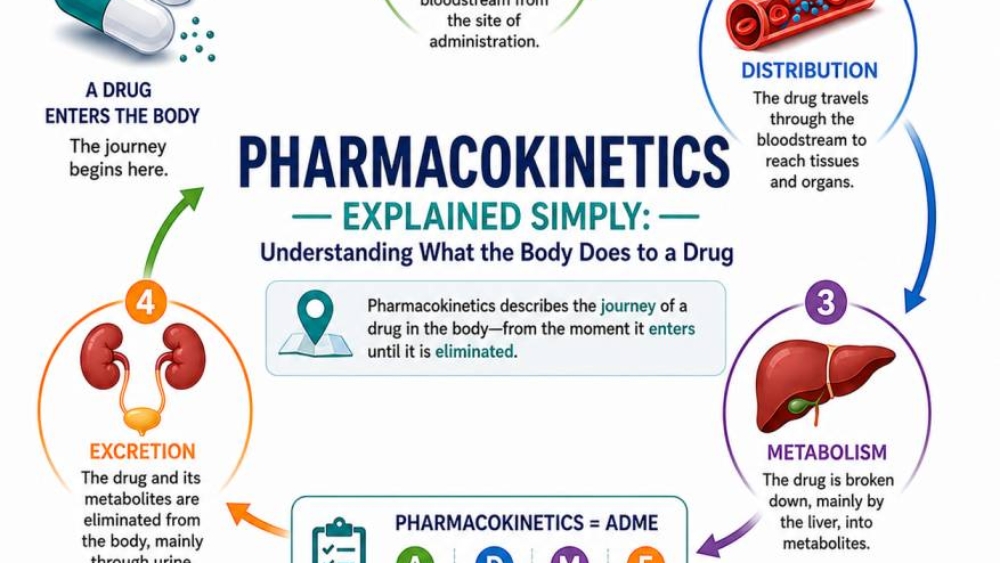
Pharmacokinetics explains what the body does to a drug after it enters the body. It describes how a medicine is absorbed, distributed, metabolized, and eventually eliminated. These four processes determine how quickly a drug starts working, how strong its effects will be, how long it remains active, and when it leaves the body.
For healthcare professionals, pharmacokinetics is essential for selecting the right drug, dose, and dosing schedule. For patients, understanding these basic principles helps explain why medications must be taken exactly as prescribed. This article explains pharmacokinetics in simple language, making it easy for students, healthcare workers, and anyone interested in learning how medicines work inside the body.
What Is Pharmacokinetics ?
Pharmacokinetics is the branch of pharmacology that studies the movement of drugs through the body over time. It examines how the body absorbs, transports, changes, and removes medications after they are administered.
A simple way to remember pharmacokinetics is by the acronym ADME, which represents the four major stages of a drug’s journey:
- A – Absorption
- D – Distribution
- M – Metabolism
- E – Excretion
Why Is Pharmacokinetics Important?
Every patient responds differently to medication. Factors such as age, body weight, genetics, liver function, kidney health, and the presence of other diseases can all influence how drugs behave inside the body.
Understanding pharmacokinetics helps healthcare professionals:
- Choose the correct dosage.
- Determine how often a medicine should be taken.
- Reduce the risk of side effects.
- Prevent drug toxicity.
- Improve treatment outcomes.
- Adjust doses for children, older adults, and patients with liver or kidney disease.
The Four Stages of Pharmacokinetics (ADME).
1. Absorption.
Absorption is the process by which a drug moves from the site where it is administered into the bloodstream.
Once a medicine reaches the bloodstream, it can be transported throughout the body to its target tissues.
Routes of Drug Administration
The route by which a medication enters the body greatly influences how quickly absorption occurs.
Common routes include:
- Oral tablets and capsules
- Intravenous (IV) injections
- Intramuscular injections
- Subcutaneous injections
- Inhalation
- Topical creams and ointments
- Eye or ear drops
- Rectal suppositories
- Transdermal patches
Intravenous medications bypass the absorption stage because they are delivered directly into the bloodstream, producing rapid effects.
Factors Affecting Absorption
Several factors influence how well a drug is absorbed, including:
- Blood flow at the absorption site
- Drug formulation
- Solubility of the drug
- Stomach acidity
- Presence of food
- Intestinal motility
- Surface area available for absorption
2. Distribution.
After entering the bloodstream, the drug is transported throughout the body. This movement is called distribution.
The circulatory system carries drugs to various organs, tissues, and cells where they produce therapeutic effects.
However, drugs do not spread evenly throughout the body. Some accumulate in fatty tissues, while others remain mainly in the bloodstream or concentrate in specific organs.
Factors Influencing Distribution
Several factors determine how widely a drug is distributed:
- Blood circulation
- Tissue permeability
- Plasma protein binding
- Body fat percentage
- Water content
- Organ function
Highly protein-bound drugs remain in the bloodstream longer, whereas unbound drugs can move more easily into tissues.
Special Protective Barriers
The body contains natural barriers that limit drug distribution.
One of the most important is the blood-brain barrier, which protects the brain by allowing only certain substances to pass through. This barrier prevents many medications and harmful chemicals from entering the brain.
Similarly, the placental barrier limits—but does not completely prevent—the passage of drugs from a pregnant woman to the developing fetus.
3. Metabolism.
Metabolism is the process by which the body chemically changes drugs into forms that are easier to eliminate.
The liver is the primary organ responsible for drug metabolism because it contains specialized enzymes capable of modifying many different medications.
Phase I Metabolism
In the first phase, liver enzymes alter the drug through chemical reactions such as oxidation, reduction, or hydrolysis. These changes often prepare the drug for the next stage of metabolism.
Phase II Metabolism
During the second phase, the drug or its metabolites combine with naturally occurring substances such as glucuronic acid or sulfate. This process increases water solubility, making elimination easier.
Active and Inactive Metabolites
Some drugs become inactive after metabolism and lose their therapeutic effects. Others are converted into active forms that produce the desired medical response. These medications are known as prodrugs.
The speed of metabolism varies from person to person due to genetic differences, age, liver function, and interactions with other medications.
4. Excretion.
Excretion is the removal of drugs and their metabolites from the body after they have produced their therapeutic effects.
The kidneys are the primary organs responsible for drug elimination through urine.
Other routes of excretion include:
- Bile
- Feces
- Sweat
- Saliva
- Tears
- Breast milk
- Exhaled air
Bioavailability.
Bioavailability refers to the proportion of an administered drug that reaches the bloodstream in an active form.
Intravenous drugs have 100% bioavailability because they enter the circulation directly.
Oral medications often have lower bioavailability because part of the drug may be destroyed in the digestive tract or metabolized by the liver before reaching the bloodstream. This process is known as the first-pass effect.
Higher bioavailability generally results in more predictable therapeutic effects.
Drug Half-Life.
Drug half-life is the time required for the concentration of a medication in the bloodstream to decrease by half.
Half-life influences:
- Frequency of dosing
- Duration of drug action
- Time required for complete elimination
For example, a medicine with a short half-life may need to be taken several times a day, while a drug with a long half-life may only require one daily dose.
Therapeutic Window.
The therapeutic window is the range of drug concentrations that produces the desired medical effect without causing significant side effects.
If drug levels fall below this range, treatment may be ineffective. If levels rise above it, toxicity becomes more likely.
Some medications have a wide therapeutic window, making them relatively safe. Others have a narrow therapeutic window and require close monitoring to ensure patient safety.
Factors That Affect Pharmacokinetics.
Many factors influence how drugs move through the body.
Age
Newborns and older adults often metabolize and eliminate drugs more slowly than healthy adults, requiring dose adjustments.
Body Weight and Composition
Differences in body fat and muscle mass affect drug distribution and dosage requirements.
Liver Function
Since the liver is responsible for drug metabolism, liver disease can slow drug breakdown and increase the risk of toxicity.
Kidney Function
Reduced kidney function delays drug excretion, allowing medications to accumulate in the body.
Genetics
Inherited genetic variations influence enzyme activity, affecting how quickly drugs are metabolized.
Food and Diet
Some foods enhance drug absorption, while others reduce it or interfere with metabolism. Healthcare providers often recommend taking certain medicines with food and others on an empty stomach.
Drug Interactions
Taking multiple medications can alter absorption, metabolism, or elimination. Some drugs increase the effects of others, while some reduce their effectiveness.
Practical Applications of Pharmacokinetics.
Knowledge of pharmacokinetics is applied every day in clinical practice.
Healthcare professionals use pharmacokinetic principles to:
- Select appropriate drug doses.
- Determine dosing intervals.
- Adjust medications for organ impairment.
- Monitor blood drug concentrations.
- Prevent adverse drug reactions.
- Improve individualized patient care.